

Author
No results available
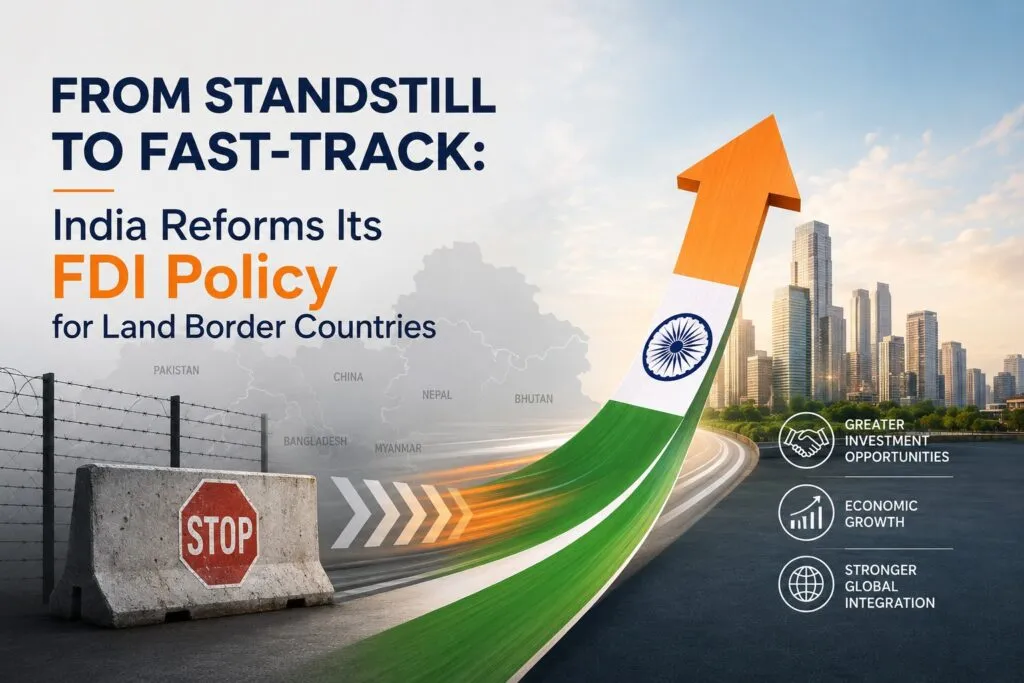
On 17 April 2020, at the height of the COVID-19 pandemic, India introduced Press Note 3 of 2020 Series, amending its Consolidated FDI Policy to require prior government approval for all foreign direct investment from any country sharing a land border with India. The changed was aimed at preventing Chinese investments into India, while there were ongoing military tensions at the Line of Actual Control. There was also the fear of opportunistic acquisition of Indian companies at a time of market distress induced by Covid.
The countries covered under this framework are China (including Hong Kong and Macau), Pakistan, Bangladesh, Nepal, Bhutan, Myanmar, and Afghanistan — together referred to as Land Bordering Countries or LBCs. The requirement applied not only to direct investments from these jurisdictions but to any investment where the “beneficial owner” was situated in or was a citizen of such a country, regardless of the intermediate jurisdiction through which the investment was routed. PN3 effectively prescribed that any beneficial ownership traceable to an LBC required government approval. The FDI Policy at that stage did not consider either the materiality of the investment or indirect investments in layered ownership structures. The practical consequence of this policy change was damaging in ways that cut well beyond the China-specific security concern that the policy was designed to address. Global private equity and venture capital funds with diversified limited partner bases were inevitably exposed to investments from Chinese residents although in many cases the investments were either insignificant or offered no control to the Chinese residents. These funds were effectively barred from investing in Indian companies under the automatic route. The same difficulty confronted globally listed companies whose dispersed shareholding bases made it practically impossible to guarantee the absence of any LBC-linked shareholding. The DPIIT received multiple representations over this period from PE and VC funds, industry associations, and foreign investors seeking a defined threshold, a materiality standard, and faster decision timelines on pending applications. The gravity of the situation may be understood through a few data points. Between April 2020 and April 2024, 526 FDI proposals were submitted for government approval under the PN3. Of these, 124 were approved, 201 were rejected, and approximately 200 remained pending, in some cases for several years, without a decision either way. The absence of any public data on PN3 outcomes compounded the uncertainty for investors trying to assess the likelihood and timeline of approval.
Six years later, on 10 March 2026, the Union Cabinet, chaired by Prime Minister Narendra Modi, approved a set of amendments to recalibrate the position on investments from LBCs. The Government has finally relented by offering much sought after clarity on PN3 by making three crucial changes.
First, a formal definition of “beneficial owner” has been introduced within the FDI Policy framework, aligned with the standard under the Prevention of Money Laundering (Maintenance of Records) Rules, 2005. The PMLA standard sets the beneficial ownership threshold at 10% of shares, voting rights, or profit entitlement.
The practical effect is significant. Investments where entities from LBCs hold non-controlling beneficial ownership of up to 10% may now proceed through the automatic route, subject to the applicable sectoral caps and standard compliance requirements. The investee company is required to report such investments to DPIIT, but no prior government approval is needed. The beneficial ownership test is to be applied at the investor entity level, meaning that a global PE fund with a Chinese LP holding below 10% of the fund and exercising no control can invest in India without Government approval under PN3. This directly unblocks FDI inflows for Indian startups and deep-technology companies, which had been most acutely affected by PN3.What remains unchanged, however is that 10% automatic route applies only to non-controlling beneficial ownership. Any LBC entity holding more than 10% beneficial ownership, or exercising control over the investee regardless of shareholding level, continues to require prior government approval. The government approval requirement for Pakistan and Bangladesh remains fully in force with no relaxation under the 2026 amendments. Similarly, defense, space, and atomic energy remain excluded from any LBC investment at all, regardless of ownership level.
Second, for investments that do require government approval, either because LBC beneficial ownership exceeds 10% or because the investor exercises control, a binding 60-day decision timeline has been introduced for a defined list of strategic manufacturing sectors. Prior to this change, no statutory or binding deadline existed for PN3 approvals. The SOP’s indicative timeline of 12 weeks from the date of application was regularly exceeded, and proposals in politically sensitive sectors could remain pending without a decision for years. The sectors qualifying for the 60-day fast-track are, capital goods, electronic capital goods, electronic components, polysilicon and ingot-wafer manufacturing, electronics system design and manufacturing (ESDM), solar cells and modules, semiconductor fabrication (fabs), assembly, testing, marking and packaging (ATMP), and outsourced semiconductor assembly and testing (OSAT). This list is directly aligned with the government’s Production Linked Incentive scheme priorities. The list may be expanded or amended by the Committee of Secretaries on FDI (CoS-FDI), headed by the Cabinet Secretary, providing administrative flexibility to respond to emerging strategic priorities without requiring a new Cabinet decision.
A significant condition has been attached to fast-track approvals, i.e. majority ownership and control of the investee company must be retained by resident Indian citizens or Indian-owned and Indian-controlled companies. This condition is intended to preserve the core security rationale of PN3, while removing the timeline uncertainty that had deterred even structurally acceptable proposals from entering the approval pipeline. The expeditious 60-day timeline is designed to let Indian companies enter joint ventures with LBC partners to access technologies and integrate with global supply chains, without facing the multi-year approval uncertainty.
Third, alongside the substantive policy amendments, DPIIT has issued a revised Standard Operating Procedure dated 4 May 2026 for processing FDI proposals requiring government approval. The new SOP replaces the August 2023 SOP and introduces a dedicated Annexure VII specifically for investments from LBCs. Several procedural improvements have been made for investors seeking approval under PN3. The entire application process is now to be conducted through the National Single Window System (NSWS) and the Foreign Investment Facilitation Portal (FIFP). All proposals must be filed digitally with a Digital Signature Certificate by the investor entity. The investee entity may no longer file on behalf of the investor. All inter-agency communications, including security clearances from the Ministry of Home Affairs and geopolitical assessments from the Ministry of External Affairs, are processed through the same digital workflow, replacing the fragmented email-based exchange that characterised earlier practice. All comments and clearances from MHA, MEA, and RBI must now be uploaded directly on the portal, creating a single auditable record of the approval process.
The SOP prescribes a sequenced timeline, DPIIT transfers the proposal to the Competent Authority (the relevant Administrative Ministry or Department) within two working days of receipt. The Competent Authority is required to communicate its decision within 12 weeks for standard PN3 proposals, reduced to 60 days for fast-track manufacturing sector proposals. Time taken by the applicant to cure deficiencies is excluded from the clock. Where a Competent Authority proposes to reject a proposal or impose conditions beyond those in the FDI Policy, it must seek DPIIT’s concurrence. This is intended to be a safeguard against inconsistent treatment across ministries that was a recurring source of investor complaint under the earlier regime.
A clear indication from the SOP is that in any transaction, FDI approval under PN3 must begin before signing. A proposal supported by a clean and fully documented ownership chart, transparent beneficial ownership disclosures at each level of the investor structure, complete transaction documents, and a coherent analysis of FEMA sectoral compliance and pricing is far more likely to move within the SOP timelines, and is far less likely to attract requests for additional documents that stop the clock, than a proposal filed as an afterthought once the commercial deal is signed.
India’s 2026 recalibration of the LBC framework is, as the government itself has described it, a calibrated reform. The Government has not abandoned the security rationale that justified PN3 in 2020, controlling investments by LBC entities still require government approval and Pakistan and Bangladesh remain subject to the full approval requirement with no relaxation. Sensitive sectors remain entirely closed to LBC investment. The 60-day fast-track requires Indian majority control as a condition of approval.
For investors from LBC jurisdictions, particularly Chinese technology and manufacturing groups, the reform is an opening, but one that operates within clearly defined boundaries. The message from the Indian government is that India wants the capital, technology, and the supply chain integration that LBC ( particularly Chinese) investment can bring to its manufacturing sector, and it is prepared to create the regulatory conditions necessary to attract it. The Government however remains skeptical of allowing control of its strategic manufacturing assets in the hands of foreign entities whose home governments are geopolitical counterparts in an uncertain regional environment.

posted 16 minutes ago

posted 39 minutes ago

posted 1 hour ago

posted 1 hour ago

posted 2 hours ago

posted 3 hours ago

posted 3 hours ago

posted 3 hours ago

posted 3 hours ago

posted 4 hours ago

posted 5 hours ago
No results available
Find the right Advisory Expert for your business
Sign up for the latest advisor briefings and news within Global Advisory Experts’ community, as well as a whole host of features, editorial and conference updates direct to your email inbox.
Naturally you can unsubscribe at any time.
Global Law Experts is dedicated to providing exceptional legal services to clients around the world. With a vast network of highly skilled and experienced lawyers, we are committed to delivering innovative and tailored solutions to meet the diverse needs of our clients in various jurisdictions.
Global Advisory Experts is dedicated to providing exceptional advisory services to clients around the world. With a vast network of highly skilled and experienced advisors, we are committed to delivering innovative and tailored solutions to meet the diverse needs of our clients in various jurisdictions.

Send welcome message
